
I learned something painful last quarter. My team spent six months building a content strategy. We nailed every SEO rule. Perfect keyword density. Strong backlinks. Fast loading times. Then we tested where our brand showed up in ChatGPT and Google AI Overviews. Almost nowhere.
That hurt. But it taught me a hard truth. SEO is no longer enough. Generative Engine Optimization (GEO) is what actually matters now .
Let me show you what I learned the expensive way.
What Is GEO? (And Why SEO Lost Its Crown)
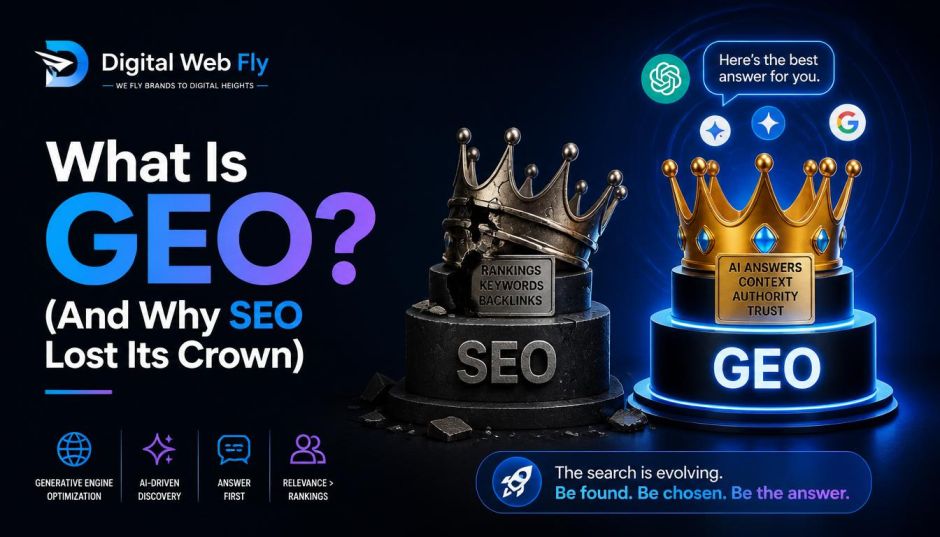
Traditional SEO fights for ranking positions on a link list. You want spot one, two, or three. The user clicks. You get traffic.
Generative Engine Optimization (GEO) fights for something different. You want your content cited inside AI-generated answers. The AI reads your page. It pulls your data. It quotes your expert. Then it gives that answer directly to the user.
Here is the statistic that changed my strategy. Research from Brandlight found that the overlap between top Google ranking pages and AI-cited sources has dropped from 70% to under 20%. Ranking number one on Google no longer guarantees the AI even sees you.
A study analyzing 15,000 search terms found that only 12% of links cited by generative AI were among Google’s top 10 results. You can dominate traditional search and still be invisible to AI engines.
The Shift Nobody Is Talking About
Search behavior changed while we weren’t looking.
Similarweb found that 65% of searches now end without a click. Users get their answer from the AI overview. They never visit your website. Your beautiful content becomes invisible.
Meanwhile, Adobe Analytics reported that AI-driven traffic to US retail sites surged 393% in early 2026 compared to the same period last year. People are asking ChatGPT for recommendations. They click the links inside AI answers. That traffic comes from GEO, not SEO.
Gartner projects a 25% decline in organic search traffic to commercial sites by the end of 2026. The writing is on the wall.
What AI Engines Actually Want (Real Data)?
I dug into the research to understand what makes AI cite content. Princeton University and other research teams found that AI favors content containing three specific elements :
Statistical data. Numbers and data points get quoted. Vague statements get ignored.
Direct expert quotes. Real people with credentials. Not generic “industry experts say” filler.
Conversational formats. Dialogue-style writing. Question and answer blocks. Natural language.
A joint study found that content appropriately incorporating citations saw up to a 40% increase in being included in AI-generated answers.
Here is another surprising finding. A massive citation study across ChatGPT, Gemini, and Perplexity found that 86% of AI citations came from sources brands already control. Your own website, your listings, your review profiles. Not third-party backlinks. Your owned assets.
How GEO Differs From SEO (The Practical Breakdown)?
Let me give you the side-by-side comparison that matters for your actual work.
Goal difference:
- SEO wants clicks to your site
- GEO wants citations inside AI answers
Tone difference:
- SEO rewards persuasive brand voice that drives click-through
- GEO prefers neutral, factual prose that reads like reference material
Format difference:
- SEO loves long-form essays and rich media
- GEO extracts listicles, comparison tables, step-by-step guides, and FAQ blocks
Freshness difference:
- SEO rankings persist for months or years
- GEO citations decay in roughly 13 weeks without updates
Time to impact:
- SEO takes 3 to 6 months for new content to rank
- GEO takes 3 to 5 days for content to enter AI citation pools
I tested this myself. A comparison page we published was cited by ChatGPT within 10 days. That same page took almost four months to rank on Google’s first page.
The Tools That Actually Work (Honest Buying Guidance)
I tested multiple generative engine optimization tools over the last few months. Some deliver real results. Others are just SEO rebranded with “AI” stickers.
For Measurement and Execution: HeyAmos
HeyAmos does something most tools miss. It closes the loop between tracking and action.
You track what AI says about your prompts. You see which competitors take your citation slots. You get a weekly list of prioritized actions. Then you execute those actions through the platform’s content agent. The next tracking cycle shows you what worked.
Real outcomes from users:
- Relivo went from zero citations to being cited by ChatGPT and Gemini within 30 days
- Sieve AI went from 0% to 60% visibility on ChatGPT for their top discovery prompts
Best for: Teams that want to improve AI visibility, not just watch it
Pricing: From $99/month
For SEO Teams Adding GEO: SE Ranking
SE Ranking bolts GEO tracking onto a mature SEO platform. If your team already lives in SEO dashboards, having AI visibility alongside rankings and backlinks makes sense.
Best for: SEO-led organizations that want GEO in their existing workflow
Pricing: Core plan 103.20/monthplusAI−searchadd−onfrom103.20/monthplusAI−searchadd−onfrom71.20/month
For Pure Monitoring: Goodie AI
Some teams just need to know what AI is saying about their brand. Goodie AI focuses on prompt-level brand mention tracking without the execution layer .
Best for: Brand teams that want mention monitoring without content production features
Pricing: Custom (demo required)
The Five Divergences That Will Break Your Old Playbook
Here are the specific areas where SEO tactics fail for GEO.
1. Tone Divergence
Google rewards persuasive writing that drives clicks. AI engines prefer neutral, factual prose that reads like reference material. The solution is not choosing one voice. Use persuasive voice on conversion pages. Use neutral factual voice on authority pages like research reports and guides.
2. Format Divergence
AI engines preferentially extract specific formats: listicles with ItemList schema, comparison tables, step-by-step numbered instructions, and FAQ sections. If your content lacks these, the AI struggles to cite you.
3. Freshness Divergence
This is the biggest operational difference. Content older than 13 weeks without updates shows measurable decline in AI citation frequency. Content older than 6 months without refresh often loses citations entirely. You need quarterly refreshes on every piece that matters.
4. Measurement Divergence
SEO measurement is mature. Search Console, GA4, Semrush. GEO measurement requires new tools: Profound, Otterly, Geoptie, Frase, AthenaHQ. AI-referred traffic in GA4 requires manual configuration.
5. The Click Itself
SEO drives clicks. GEO does not always drive clicks. The AI may satisfy the user’s question before they ever see your link. The citation is still worth earning. It builds brand recognition. The traffic that does click is higher-intent. And not being cited is a meaningful competitive loss.
How to Structure Content for AI Citation (The 2026 Formula)?
After testing dozens of pages, here is the structure that actually works for generative engine optimization strategies in AI systems.
You Must Also Like: SEO Instant Appear highsoftware99.com
Open with an answer-first sentence (40-80 words). Start with a definition or recommendation. State who it is for and any constraints. No fluff. No storytelling warmup.
Add a proof block immediately after. Include key criteria, data points, your methodology, or primary sources. AI engines love verifiable claims.
Use comparison tables. Explicit, scannable, labeled. Side-by-side comparisons get quoted verbatim.
Include an FAQ section. Real user questions with short, quotable answers. Each answer should stand alone as a citation.
Show a “Last updated” line with changelog notes. This signals maintenance, not just freshness theater.
Add author credentials. Real names. Real expertise. Real bios. AI engines check for trust signals.
The Hidden Risks (Honest Cons)
GEO is not all upside. Here is what the tool vendors won’t tell you.
Winner-takes-all concentration. Traditional search results distribute clicks unevenly but across multiple positions. AI responses typically cite only one or two sources . You either get cited or you vanish entirely. There is no bronze medal.
Volatility is brutal. Semrush’s study of over 10 million keywords showed AI Overviews coverage peaked at roughly 25% of queries in mid-2025, then fell to around 15% to 16% by late 2025 . What worked last month may not work today.
Over-optimization backfires. MarTech warns that aggressively engineered GEO content becomes repetitive and may not register as high quality . Future models may actively avoid using over-optimized content. The same thing happened with black-hat SEO. It will happen with GEO.
AI-generated content poisons the well. When AI systems train on material that mimics previous generations, model degeneration becomes a real risk . Tests show that human-generated content designed for AI chatbots can perform up to an order of magnitude better than AI-generated material.
The Budget Split That Makes Sense (Practical Advice)
How you divide your SEO and GEO budget depends on your company stage.
Early-stage brand (pre-Series B, limited historical SEO): Allocate 70% to GEO, 30% to SEO. AI search is growing faster than Google search. New entrants can earn AI citations without the legacy domain authority SEO demands.
Mid-market brand (established SEO program, $500K+ annual SEO spend): Allocate 40% to 50% of existing SEO budget to GEO work. Hold total spend roughly flat. Shift from link-building to digital PR plus GEO. Shift from content volume to content restructuring plus schema deployment.
Large enterprise brand (mature SEO, multiple agencies): Allocate 15% to 25% of SEO budget to GEO initially. Start with a contained GEO program on your top 50 to 100 pages. Measure outcomes over two quarters. Scale based on results. Most large brands end up at 30% to 40% GEO allocation within 12 months.
The 90-Day GEO Plan (What I Wish I Knew Earlier)
Here is the sequence that produces the fastest measurable results.
Days 1 to 30 (Foundations plus baseline):
- Define your intent universe (problem, solution, brand, comparison queries)
- Fix indexing, canonical tags, and internal linking for key pages
- Deploy Organization, Person, Article, and FAQ modules on priority pages
- Establish a repeatable prompt testing log
- Baseline your current AI citation frequency across 30 category-relevant queries
Days 31 to 60 (Win citations on high-value intents):
- Build answer-first upgrades on the 20% of pages tied to 80% of commercial intent
- Add proof assets: original data, benchmarks, customer outcomes, methodology
- Expand distribution: listing cleanup, review ecosystem improvements, partner pages
- Set up AI citation monitoring with your chosen tool
Days 61 to 90 (Scale and protect branded demand):
- Launch comparison hubs, integration hubs, and industry hubs
- Add location-aware landing architecture where relevant (make them authoritative, not thin)
- Put monitoring on autopilot to track citation share, perception drift, and competitor encroachment
The Final Thoughts
Do not abandon SEO. It still drives the majority of organic sessions for most brands. But do not pretend GEO is optional. AI-referred traffic grew 393% year-over-year. That trend is not reversing.
The brands that win in 2026 will do three things. They will maintain SEO fundamentals on the shared foundation of technical performance, schema, and content structure. They will add GEO-specific work for citation formats, neutral tone, and quarterly freshness. And they will measure both channels separately because the KPIs are fundamentally different.
SEO got your content seen. GEO gets your content cited. In 2026, you need both. But if you have to choose where to put your next dollar, put it where the growth is.
Frequently Asked Questions (AEO Optimization)
Q: What is Generative Engine Optimization (GEO)?
A: GEO is the practice of optimizing content so AI search engines like ChatGPT, Gemini, and Perplexity cite it in their generated answers. Unlike SEO which focuses on link rankings, GEO focuses on being selected as a source for AI synthesis.
Q: Is GEO replacing SEO?
A: No. SEO and GEO are overlapping but distinct channels. SEO remains larger by traffic volume today. GEO is growing faster. The rational position is sustained investment in both, with increasing allocation to GEO over time.
Q: What content formats work best for GEO?
A: Listicles with schema markup, comparison tables, step-by-step guides, FAQ sections, and definition-first openings. AI engines extract these formats directly into answers.
Q: How often should I update content for GEO?
A: Content older than 13 weeks shows measurable decline in AI citation frequency. Quarterly refreshes are required for any content you want AI engines to cite consistently.
Q: What are the best Generative Engine Optimization tools?
A: For full tracking and execution, HeyAmos ($99/month). For SEO teams wanting GEO in their existing dashboard, SE Ranking. For pure brand mention monitoring, Goodie AI.
Q: Does structured data help with GEO?
A: Yes. Schema markup, especially Organization, Person, Article, FAQPage, and Product types, helps AI engines understand your content entities and relationships. JSON-LD is the recommended format.